GT.BRITAIN, QUEEN ELIZABETH II, GOLD PROOF HALF-SOVEREIGNS 1980 - DATE.
The London Royal Mint struck its first gold sovereign in 1489 during the reign of Henry VII. This coin became known as a "sovereign" because the obverse design depicted the King enthroned in regal splendour. It was the first gold coin produced with a value of one pound or twenty shillings, it was the largest coin yet issued in England and also the most beautiful. The half-sovereign was introduced a few years after, during the reign of King Henry VIII (1509-1547), in the year 1544, nearly 300 years before the modern coinage period. The modern sovereign, smaller and featuring on the reverse the classic St. George and the dragon design by Benedetto Pistrucci and the half-sovereign featuring the Royal Arms were introduced in 1817, during the reign of King George III (1760-1820), taking the form in which we know them today.
Gold half-sovereigns continued to be issued by the Royal Mint in London for the reigns of King George IV (1821-1830), King William IV (1831-1837), Queen Victoria (1838-1901), King Edward VII (1902-1910), and King George V (1911-1915).
After 1915 the Royal Mint did not issue currency gold half-sovereigns until 1982. This was during the reign of Queen Elizabeth II, when the first bullion half-sovereign issued only for that year.
The year 2000 was for particular interest to currency half-sovereign collectors, as for the first time since 1982 a bullion type gold half-sovereign was struck by the Royal Mint and continued to be struck yearly ever since.
Although proof half-sovereigns were struck for every reign until 1937, it was in 1980, during the reign of Queen Elizabeth, when the London Royal Mint reissued the gold proof half-sovereign as a collector-edition, and continued the issue yearly ever since, omitting the year 1981. Every coin came in its own original box with a COA.
QUEEN ELIZABETH II
The Reign of Queen Elizabeth II (1952- ) House of Windsor.
Born: 21 April 1926.
Accession: 6 February 1952.
Married: Philip of Greece and Denmark, 20 November 1947.
Coronation: Tuesday, 2 June 1953.
Children: three sons, one daughter.
Celebrating her Diamond Jubilee Year 2012.
Six types of proof half-sovereigns have been struck by the Royal Mint during Queen Elizabeth's reign:
The first type (1980-1984) shows the Queen facing right and wearing a coronet, and, on the reverse, the design of St.George slaying the Dragon.
The second type (1985-1997) shows the Queen facing right wearing a diadem, necklace and earings, and the reverse, once more, features Pistrucci's St.George slaying the Dragon.
During this period the year 1989 occured and it was the very year that marked the 500th anniversary of the gold sovereign, and so, to mark this special year, the Royal Mint struck this third type proof half-sovereign. This 1989 issue shows the enthroned effigy of the Queen facing and seated, wearing a crown and robed in superb regal splendour. The reverse features the Royal Arms placed in the centre of a large Tudor rose with the crown above.
The fourth type (1998- Date) features the Old bust of the Queen facing right and wearing a tiara and the reverse the design of St. George slaying the Dragon.
The year 2002 Queen Elizabeth completed fifty years of a truly wonderful reign (Golden Jubilee). To mark this great occasion, the Royal Mint struck a special issue with the reverse featuring the Ensigns Armorial of the United Kingdom within a plain shield surmounted by the royal crown.
The sixth type was struck in 2005 with a new modern design of St.George and the Dragon on the reverse.
PROOF COINS
A newly minted proof coin is also Un-circulated, however it is the way it is made that causes a difference in appearance and qualifies it as a "proof". Coins are produced when two dies strike a blank piece of metal with tremendous force. One die is engraved with the front (obverse) design for the coin. The other die has the back (reverse) coin design on it.
A proof coin is made with
a specially polished and treated die!
By treating the die in a special way, the coins it produces have a different appearance. The background (field) design of the coin die is polished, resulting in a mirror-like look on the coin it strikes. This gives the finished coin a frosted look (frosting) on the raise parts of the design, with a mirror like finish on the background. This contrasting finish is often called "cameo". On some older coins a cameo appearance is quite rare. The attribute "CAMEO", when added to a coin's description, means cameo appearance. "ULTRA CAMEO" indicates the cameo appearance is strong and easy to observe.
Proof coins are struck twice, or more!
Not only are proofs made using specially treated dies, each coin is struck two or more times by the coin die. By striking it more than once the metal is forced into all the crevices of the die, thereby giving a very fine detail to the image on the coin. This fine detail does not appear on some non-proof coins.
Grading proofs
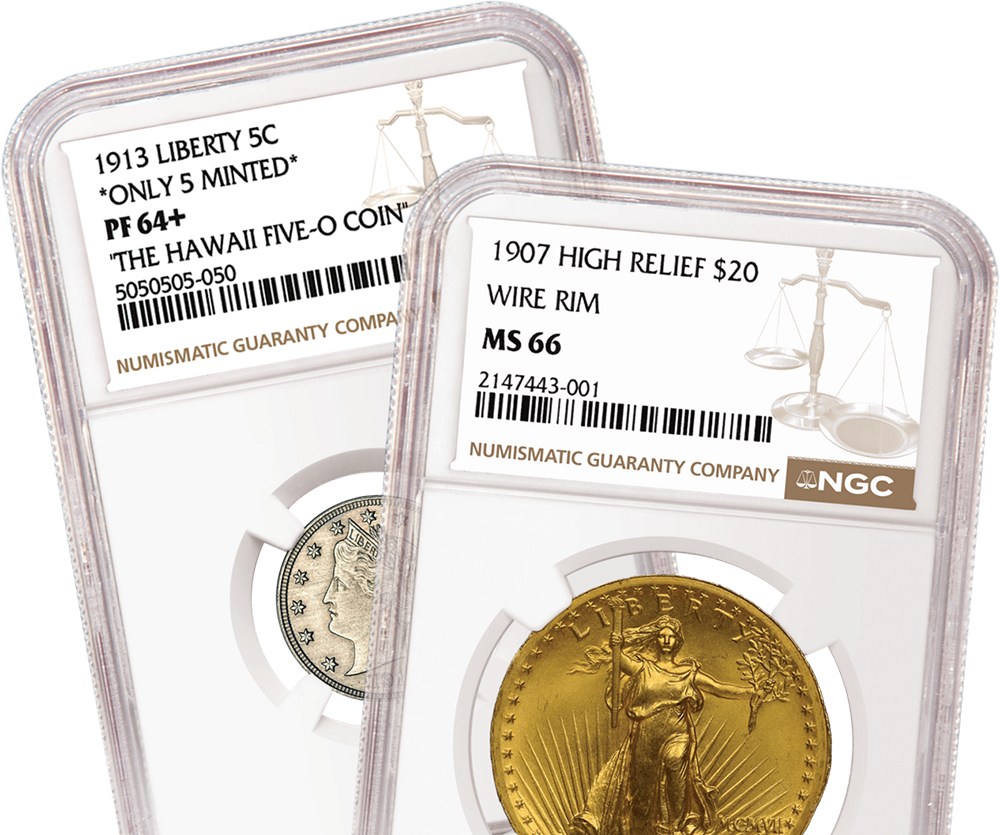
Today's grading of proofs is similar to the grades used for uncirculated coins. The attribute "PR" or "PF" stands for "proof", and is used instead of the MS (mint state) to indicate a proof coin. Proofs (that are also uncirculated) will be graded PF 60 to PF 70, with PF 70 being rare or nonexistent in some cases. Because a proof coin can be mishandled or receive wear by cleaning or handling, proof grades can extend below PF 60. Like uncirculated coins, proofs can experience toning, tarnish or darkening.
REFERENCES
COINS OF ENGLAND & THE UNITED KINGDOM, 45th Edition 2010, by SPINK.
THE GOLD HALF-SOVEREIGN, 2nd Edition 2004, by MICHAEL A. MARSH.
This fantastic collection includes all of the proof, collector-edition, gold half-sovereigns of Queen Elizabeth II, minted by the Royal Mint 1980-date. All coins are of superb quality, with full strike, frosted cameo devices and bright reflecting fields. Twelve of these beauties got the amazing PF70 Ultra Cameo grade, the rest of them the PF69 Ultra Cameo. NGC,Thank You.阅读全文
1/2 SOVEREIGN 1980-2010, Proof Issue, (ELIZABETH II).